Application catalogs
The Catalog section of the admin portal connects the container registries that supply analysis applications to your organization. An application catalog points at a registry namespace; once connected, the applications it holds become available for members to choose when they run an analysis (see Running analyses).
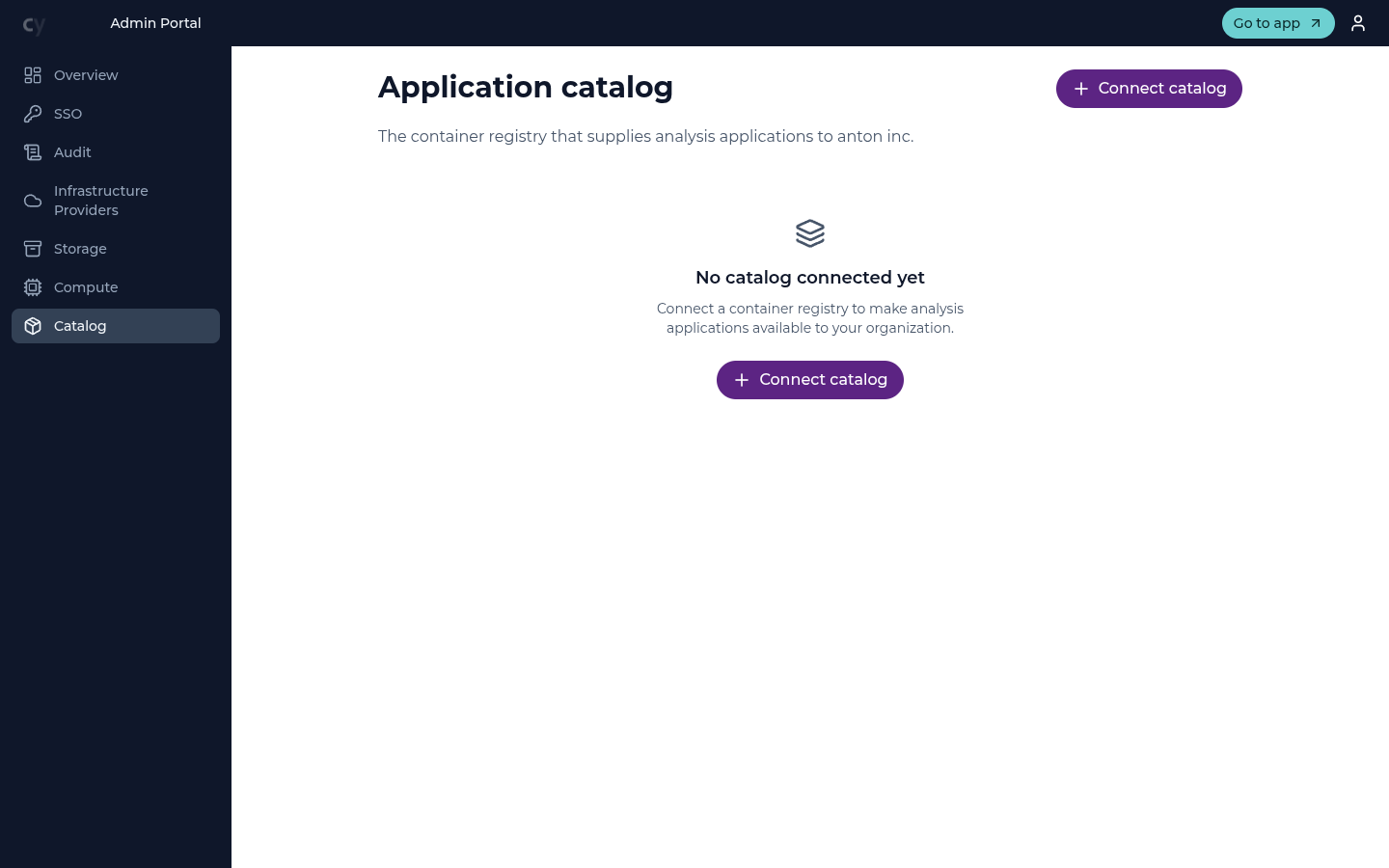
Multiple catalogs
Your organization can connect more than one catalog — for example one registry namespace holding your production applications and another holding applications still in development. The Catalog page lists every connected catalog, one row per catalog, mirroring the Compute providers view: each row shows the catalog's display name, the registry kind, the endpoint and namespace, whether it uses an access credential, and its verification status.
Register catalog stays available while other catalogs are connected, so adding a second (or third) catalog never requires disconnecting the first.
When your organization has more than one catalog, members see a Catalog selector in the application picker when starting an analysis — switching it changes which catalog's applications are listed.
Connecting a catalog
Use Connect catalog to register a registry. Each catalog has:
- a display name, which must be unique within your organization — if you type a name one of your catalogs already uses, the form tells you immediately, before you submit;
- the registry kind (Harbor or a plain OCI registry), which determines how the platform enumerates the registry's repositories;
- the registry endpoint and namespace;
- optionally, a robot account (identifier and secret) when the registry requires a credential — leave both fields empty to connect a public registry without one;
- an access scope — the organization groups whose members may use the catalog's applications, or all organization members.
Each catalog keeps its own settings: connect, re-verify, rotate the secret, edit the scope, or disconnect one catalog without touching the others.
Cluster scope
A catalog connected with a credential additionally declares which compute providers it may be used with. The registry's pull credential is provisioned only on the declared providers, so a credentialed catalog's applications run only on the clusters approved for it. A credential-less catalog needs no cluster scope — its public images can be pulled by any of your compute providers.
How it fits together
To make analysis applications available: